VTOL flight control
A custom tiltrotor airframe on PX4 dynamic control allocation — vectored yaw from differential tilt and elevons as control surfaces, managed cleanly across the hover-to-cruise transition.
control allocationtiltrotortransition
Arte Cristallino builds the hardware, firmware and autonomy behind real machines — from a VTOL drone on PX4 & ROS 2 to on-demand industrial automation: ESP32/STM32 devices tied into one centralized MQTT logic with full real-time telemetry, feedback and control. We ship what we build.
A compact, long-endurance VTOL drone for filming the Dolomites — designed as an aerospace conceptual-design program. Every choice descends from a requirement, every number is reproducible, and the whole aircraft flies as a digital twin in PX4 simulation before a single part is bought.
The airframe is a blended wing body Y-tricopter tiltrotor: two front rotors tilt from hover to cruise, a folding rear rotor lifts, and yaw is vectored from differential front tilt. It hovers like a multirotor and cruises like a wing — VTOL from unprepared alpine sites, then efficient long-range flight to loiter over a subject.
A custom tiltrotor airframe on PX4 dynamic control allocation — vectored yaw from differential tilt and elevons as control surfaces, managed cleanly across the hover-to-cruise transition.
The aircraft flies before it exists — a physics model with measured mass and inertia, over real Dolomites terrain, flown by autonomous missions: hover, transition and full mission verified in simulation.
Offboard control from ROS 2 over the standard PX4 DDS bridge, built on published path-planning and localization research — the path to onboard perception and fully autonomous missions.
Every module here was built on demand for a real manufacturing workshop, then tied into one system: ESP32/STM32 devices speaking MQTT, Modbus and Ethernet to a centralized logic with total real-time telemetry, feedback and control — an energy manager routes solar surplus into heating and batteries, a heating controller drives the biomass boiler, and relays, valves and thermostats keep the site balanced. Proprietary; available as custom builds.
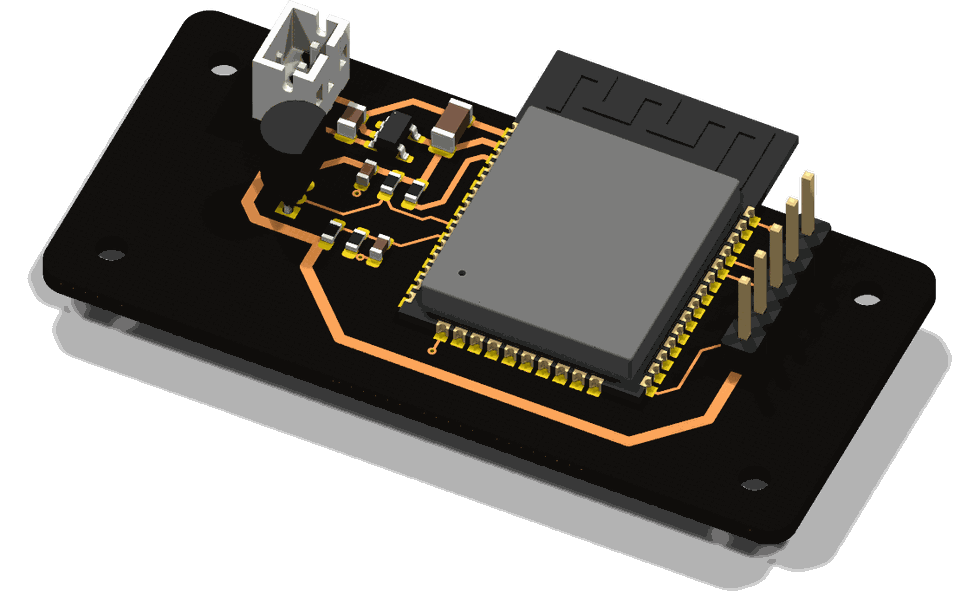
Battery-powered thermostat on our own PCB — ESP32-WROOM-32E with a low-power LDO and on-board Li-Ion charging (TP4065). Wakes from deep sleep, reads a DS18B20 probe, publishes temperature and battery over MQTT, and goes back to sleep. Auto-discovered by Home Assistant.
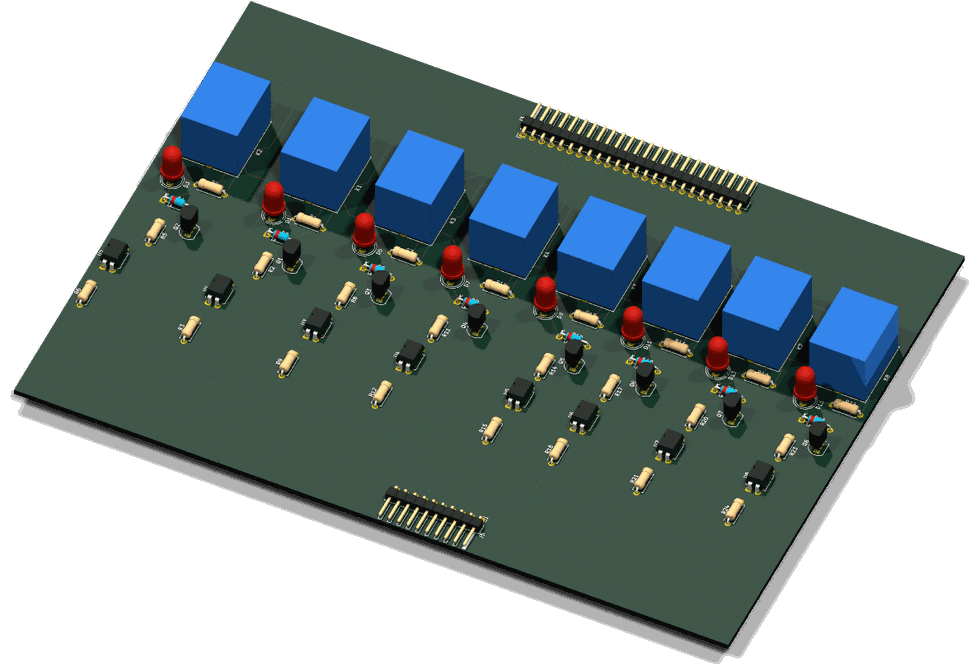
A three-board stack of our own design: ESP32 base board with integrated 230 V AC-DC supply (fused + MOV protected) plus 8- and 4-channel boards — 12 opto-isolated relay channels with flyback protection, sized to drive three-phase contactors. Ethernet (W5500) or WiFi, native MQTT with Home Assistant discovery, verified OTA updates and true pin-state feedback.
More than a PV controller — a whole-site energy manager. It monitors production, consumption and the live delta with the grid, then routes surplus where it pays off: diverting overproduction into heating resistors, charging batteries, and shifting loads toward self-produced solar. Modbus (incl. TCP) + MQTT.
Talks to a Fröling / ETA biomass boiler over its comms bus and adds full remote control: it drives the feed / stoker screw, tracks the wood-chip store, and sequences the circulation pumps and heating zones — with real-time telemetry, control and alarms over MQTT.
ESP32 module driving a motorized mixing valve. Reads feedback temperature via DS18B20 and pulses the valve toward the target setpoint, with MQTT control and Home Assistant discovery.
ESP32 controller for a reversing drive (forward/back). Counts encoder / inductive-sensor pulses and auto-reverses direction when no movement is detected within a configurable timeout. MQTT + Home Assistant.
ESP32 lux meter reading an I²C ambient-light sensor and publishing measurements over MQTT — used for lighting control and monitoring across the workshop.
The glue that keeps it running: a centralized control logic on an industrial CM4 (dual-Ethernet, 4G/5G) coordinating the whole fleet in real time, an OTA update server for the ESP32 devices, and dual-router network failover.
We build for ourselves first — then bring the same engineering to your project: from a Simulink model that proves the physics, to a drone airframe, a single board, or a full automated line.
End-to-end drone development — airframe, propulsion and flight control on PX4 or ArduPilot, VTOL & multirotor tuning, custom board ports, and a full SITL/HIL digital twin before you fly.
Physics-based models of your system in MATLAB / Simulink — thermal, hydraulic, mechanical and control dynamics — so you can see and tune how it behaves before a single part is built. The same digital-twin discipline behind our drone.
Production firmware on ESP32 and STM32 — real-time, low-power, robust. OTA updates, watchdogs and fail-safes included.
Custom boards from schematic to production-ready Gerbers, sized for your enclosure, sensors and power budget.
Path & motion planning, kinematics and control — ROS 2 integration, flight-control autonomy, and real-world tuning, from algorithm to deployment.
Tie machines into one centralized MQTT logic — real-time telemetry, feedback and control where devices coordinate, plus dashboards, alarms, logging and OTA-managed fleets.
Detection, segmentation and classification pipelines — from data and training to deployable inference for inspection, agriculture and airborne sensing.
The public work of our lead engineer — from robotics autonomy and flight-grade embedded firmware to computer vision and quant systems. Proof of the depth behind our drones and products; star counts update live from GitHub.
Intraday US-equity trading system — LightGBM with triple-barrier labeling, walk-forward validation and paper trading via the Alpaca API; reproducible and honest about its limits.
Three complementary planners — parallel sampling-based planning, efficient replanning and planning under uncertainty: the navigation core behind autonomous ground robots and UAVs alike.
Differential-drive control on TurtleBot, collision-space via Minkowski sums, weakly-supervised localization and camber control.
A Simple Open EtherCAT Slave (SOES) stack ported to the STM32F3 — real-time industrial communication on a low-cost MCU.
Work on the Klipper firmware including a custom build with coupled kinematics for a non-standard extruder.
CANopen protocol work — an SRDO-focused contribution to CANopenNode plus a MATLAB CANopen / EDS editor.
CNN crop–weed segmentation for agriculture, a mask-detection classifier, and a visual question-answering chatbot on LSTMs.
A suite of Alphacam plugins automating CNC workflows: CNC compiler, feature extraction, NC visualization and post-processing.
The Acquedotto Cortina project — a decoupled client/server web app demonstrating REST API design and a modern JS front end.
What sets us apart is that we build our own technology in-house. Rather than buying off-the-shelf boxes, we designed and deployed a complete automation system for our workshop: a fleet of ESP32/STM32 devices — each developed on demand on custom PCBs — tied together over MQTT, Modbus and Ethernet into an industrial IoT backbone we run and maintain every day.
The same discipline drives our R&D. Project ARES — a VTOL drone on PX4 & ROS 2 — is designed the way an aircraft is: every requirement traced, every number reproducible, and the whole aircraft flying as a digital twin in simulation before the first part is bought.
That hands-on experience is what we now offer to others — real firmware, real electronics, real flight code, not slideware. If you have a machine to automate or a system to fly, let's talk.
Tell us about your project — a UAV or flight-control job, a device to build, a line to automate, or firmware/PCB work. We'll get back to you within a couple of days.